A toilet that will not stop running, a pan that leaks at the floor or a bowl that will not clear is the kind of plumbing problem Canberra households put up with for weeks and then need fixed in an hour. This page covers the toilet repairs a licensed plumber handles across the ACT, from the original cisterns in ex-govie homes in Ainslie and Narrabundah to the concealed in-wall units in Braddon and Kingston Foreshore apartments, and what is involved when a repair is no longer worth it and the toilet is replaced.
Why toilets fail in Canberra homes
Canberra’s housing comes in distinct eras and the toilets follow. The 1920s to 1960s ex-govie homes of the Inner North and Inner South often still have a separate toilet room off the laundry or back verandah, sometimes with the original low-level cistern, brass float valve and rubber flush valve. The brick veneer homes of Woden, Belconnen and Tuggeranong from the 1960s to 1990s were built with close-coupled vitreous china suites, and many are on their original cistern internals after several decades of use. Gungahlin homes and the apartment towers of Belconnen, Woden and the city were built with dual-flush suites, plastic cisterns and, increasingly, concealed cisterns inside the wall.
Two local factors add to the ordinary wear. Canberra’s reactive clay soils move with the seasons, and on slab homes in Kambah, Wanniassa and Calwell that movement can shift the pan enough to break the seal at the floor. And Canberra’s cold mains water in winter causes cisterns to sweat in a heated bathroom, which is often mistaken for a leak. A plumber can tell the two apart in minutes.
Running cisterns
A cistern that runs continuously, refills on its own every few minutes or hisses after the flush has finished is usually one of three things: a worn flush valve washer that lets water trickle from the cistern into the pan, a float valve or inlet valve that no longer shuts off fully, or an overflow set too high for the mains pressure. In low-lying suburbs such as Phillip, Greenway and parts of Belconnen the mains pressure is high enough to push past a tired inlet valve, and a pressure limiting valve at the meter may be part of the fix.
The water wasted by a running toilet is significant. Icon Water charges for every kilolitre through the meter, and a cistern that trickles day and night adds to a quarterly bill long before anyone notices the sound. If your meter keeps turning with every tap off, the toilet is the first place to look. The repair is usually a new outlet valve, inlet valve or full internal kit, and for older cisterns where parts are no longer made, the plumber will explain whether a replacement cistern or a new suite is the better value.
Leaking pan seals and wet floors
Water at the base of the pan after a flush means the seal between the pan and the drain has failed. Older Canberra homes use a putty or rubber pan collar on an earthenware or cast iron outlet; newer homes use a rubber pan connector on PVC. When the seal fails, every flush pushes a small amount of sewage under the pan, into the grout and, in a timber-floored ex-govie in Dickson or Griffith, into the joists. The smell usually arrives before the visible water.
The fix is to lift the pan, replace the seal or connector, check the outlet for cracks and refit the pan on a level base. Where the floor has moved with the clay, the plumber will also check that the pan is not being rocked by an uneven tile bed, because a new seal on a rocking pan will fail again.
Blocked toilets
A toilet that fills to the rim and drains slowly, or not at all, is either blocked at the trap or blocked further down the sewer line. Trap blockages are usually wipes, sanitary products or a child’s toy, and they are cleared on the spot. If more than one fixture is backing up, or the toilet gurgles when the shower runs, the problem is in the sewer, and in the pre-1980 suburbs that often means tree roots in cracked earthenware pipe. That is a job for a drain camera and a jetter rather than a plunger, and it is covered on our blocked drains Canberra page.
One warning worth repeating: do not keep flushing a toilet that is not draining. A second flush on a full bowl goes onto the floor.
Toilet installation and replacement
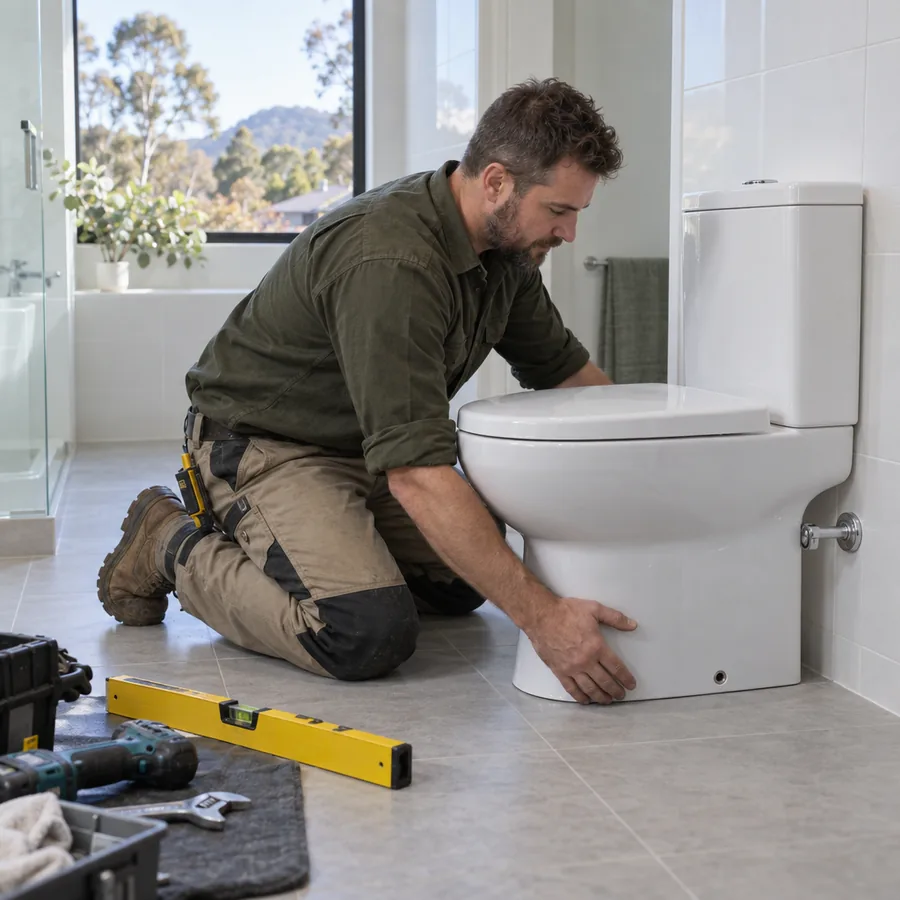
Toilet installation in Canberra is straightforward on a modern PVC outlet and more involved on the older cast iron and earthenware stubs found in Ainslie, O Connor and Narrabundah, where the plumber may need to adapt the outlet or set a new pan collar in the floor. The set-out, the distance from the wall to the centre of the outlet, determines which suites will fit, and the plumber will measure it before you buy anything.
All new toilets sold in Australia carry a WELS (Water Efficiency Labelling and Standards) rating. A modern four-star dual-flush suite uses around 4.5 litres on full flush and 3 litres on half, against roughly 11 litres for the single-flush cisterns still found in many older homes. For a household on Icon Water’s usage charges, the saving on water alone is real, and in an ex-govie home a dual-flush upgrade is often the most sensible outcome once the original cistern starts failing. Replacement is also the moment to fit a new stop tap and a rated flexible hose, and to deal with any rot or tiling damage under the old pan.
For a whole-room renovation, the toilet is one part of a larger job. See bathroom and kitchen plumbing in Canberra for that.
Apartments and townhouses
In the apartment buildings of Braddon, Kingston Foreshore, Belconnen and Gungahlin, most toilets have a concealed cistern inside the wall with a flush plate. Repairs are done through the plate opening, and the parts are specific to the cistern brand, so it helps to photograph the flush plate before calling. A leaking pan seal or cistern in an apartment is urgent because the water goes into the unit below, and strata will usually want a licensed plumber’s report.
The ex-govie townhouse complexes across Tuggeranong, in Kambah, Monash and Wanniassa, share sewer lines, so a blocked toilet in one unit can be a shared problem. The plumber will tell you whether the fault is in your unit or in the common drain, which matters for who pays.
Licensing and how the job works
Plumbing and drainage work in the ACT must be done by a tradesperson licensed by Access Canberra, and you are entitled to ask for the licence number. Across the border in Queanbeyan, Karabar and Jerrabomberra the licence is with NSW Fair Trading. When you call, you are given an honest arrival time, the call-out rate is explained before anyone is dispatched, and the repair or replacement is quoted before work starts. Most toilet repairs are finished in a single visit with parts carried on the van.
What is included
- Diagnosis of running, refilling or hissing cisterns and replacement of inlet and outlet valves
- Pan seal and pan collar replacement, including cast iron and earthenware outlets in older homes
- Clearing blocked toilets at the trap, with drain camera inspection if the sewer is involved
- Toilet installation and replacement, including set-out measurement and WELS-rated dual-flush suites
- Repairs to concealed in-wall cisterns in apartments and townhouses
- New stop taps and rated flexible hoses fitted with every replacement
- Written report for strata or insurance where water has reached another unit
Signs you should call now
- The cistern runs constantly, or refills on its own every few minutes
- Water or a sewage smell at the base of the pan after flushing
- The bowl fills to the rim and drains slowly or not at all
- The toilet gurgles when the shower or washing machine drains
- The pan rocks or has come loose from the floor
- Your water meter turns with every tap in the house off
- The flush button or lever has to be held down or jiggled to work
Do not flush a toilet that is not draining
A bowl that has filled to the rim is holding the last flush. A second flush goes onto the floor and, in an apartment, into the ceiling below. Turn the stop tap beside the cistern off, leave the bowl alone and call.
Frequently asked questions
How do I check whether my toilet is leaking from the cistern into the bowl?
Put a few drops of food colouring in the cistern, do not flush and wait about fifteen minutes. If colour appears in the bowl, the outlet valve or flush washer is letting water through and the cistern keeps refilling to replace it. This is the most common cause of a running toilet and of a water bill that has risen without explanation. It is a quick repair on most cisterns.
Why is there water on the floor around my cistern in winter?
In Canberra winters the mains water filling the cistern can be only a few degrees above freezing while the bathroom is heated. Moisture in the warm air condenses on the cold cistern and drips onto the floor, which looks exactly like a leak. If the water appears only on cold days and the cistern is dry around the lid, it is condensation. A plumber can confirm it in minutes and, if it is a genuine leak, fix it.
Can the original cistern in an ex-govie home be repaired?
Often, yes. Many 1940s to 1960s cisterns in Ainslie, Narrabundah, O Connor and Griffith take standard replacement float valves and flush washers and can be kept running for years. Where the cistern is cracked, the parts are obsolete or the single flush is using far more water than a modern suite, the plumber will explain the case for a dual-flush replacement and let you decide.
What does the WELS rating mean when choosing a new toilet?
WELS is the Australian Water Efficiency Labelling and Standards scheme, and every new toilet carries a star rating. A four-star dual-flush suite uses roughly 4.5 litres on full flush and 3 litres on half, compared with around 11 litres for an older single-flush cistern. Because Icon Water bills by the kilolitre, a higher star rating lowers the household water bill for as long as the toilet is in service.
Is a running toilet an emergency?
Not usually, but it should not wait weeks. A cistern that runs continuously wastes metered water day and night, and a worn inlet valve under high mains pressure can eventually fail open and flood the room. If you can turn the stop tap beside the cistern off between uses, the job can be booked at a normal hour. If the stop tap will not close, call sooner.
Who pays for a blocked toilet in a townhouse or apartment?
It depends on where the blockage is. A blockage in the pan or the pipe serving only your unit is your responsibility as owner or, depending on the lease, your landlord's. A blockage in the shared sewer line serving several units is a body corporate matter. The plumber will locate the blockage and put that in writing so the cost lands in the right place.
Can you repair a toilet with a concealed in-wall cistern?
Yes. Concealed cisterns in Braddon, Kingston Foreshore, Belconnen and Gungahlin apartments are repaired through the flush plate opening, and most faults, including running water and weak flushes, are fixed without opening the wall. Full replacement of the in-wall frame is a larger job that involves the wall lining and tiles, so the plumber will always try the repair first and quote the replacement only if needed.